
Old plans on the construction site: Avoid costly mistakes this way
Outdated blueprints are among the costliest sources of errors in construction. Discover how digital document management with Kibi Connect solves this challenge.

Contents
Outdated construction plans are one of the most expensive sources of errors in the skilled trades. A significant portion of all rework stems from incorrect or outdated plan documents. For site managers, project leaders, and master craftsmen, this means wasted working hours, material loss, and frustrated teams. At Weslink, we’ve developed Kibi Connect, a digital hub for non-desk workers that tackles this problem at its root. Kibi Connect consolidates plans, documents, and communication onto a single platform that works directly on the construction site.
How much do outdated construction plans really cost?
Rework due to incorrect plan documents is one of the most expensive—and most avoidable—cost factors in the construction industry. For a single business, these losses can quickly add up to a substantial portion of annual revenue.
The costs aren’t just tied to materials and labor. In practice, a single plan error often triggers a chain of follow-up problems. If a technician works from an outdated floor plan, the wrong lines are laid, drywall must be opened, and the timeline shifts by days. Subsequent trades wait, late fees loom, and customer relationships suffer.
Why do outdated plans even end up on construction sites?
The cause is almost always an information gap between the office and the site. Many trades businesses still lack a centralized system for distributing plans.
In practice, the workflow in many companies looks like this:
- Email: The latest version gets buried in inboxes or isn’t even opened on-site
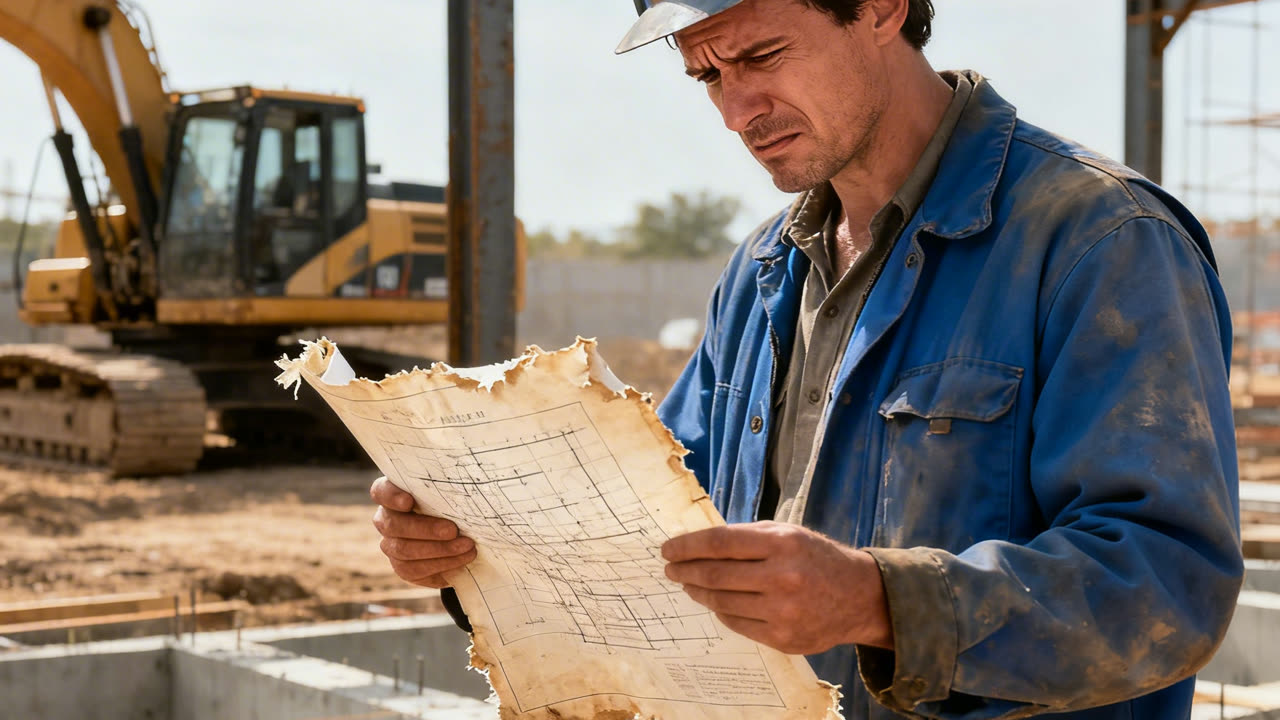
- Printouts: Paper plans are printed once and never updated—many site managers know the problem of outdated paper documents on-site
- WhatsApp: Low-quality photos of plans, without versioning, buried in endless chat threads
- Verbal transmission: “The boss said…” — a game of telephone on the construction site
The result? No one can be sure whether the plan in hand is the current one. And if in doubt, work simply begins anyway.
What risks arise beyond direct costs?
Outdated plans don’t just cause rework—they endanger safety, deadlines, and liability. Construction companies bear full responsibility, even if the error stems from poor communication.
Liability and warranty: Under VOB/B and the German Civil Code (BGB), the executing company is liable for defects in the structure. A technician working from an incorrect plan doesn’t protect the company from warranty claims—the burden of proof lies with the contractor.
Safety: In safety-critical areas like electrical installations or structural planning, incorrect plans can lead to personal injury. According to the German Social Accident Insurance for the Building Trade (BG BAU), faulty documents are a recurring factor in construction site accidents.
Schedule delays: Every plan error can set a project back by several working days. With tight sequencing of multiple trades, this impacts the entire construction phase.
How does a digital platform solve the planning chaos?
With Kibi Connect, plans are centrally stored, automatically updated, and accessible on-site via mobile devices. This eliminates information gaps at the source.
Always the latest version: Documents and plans are stored in one central location. When a plan is updated in the office, everyone involved sees the newest version on their smartphone immediately. Old versions are archived—not deleted—so the change history remains traceable.
On-site access: The Kibi Connect app gives every employee mobile access to all relevant documents, whether on the construction site, in the warehouse, or on the go. Paper printouts, which may already be outdated the next day, become obsolete.
Push notifications for changes: When a document is updated, all affected employees receive a notification. This ensures no one unknowingly works with outdated information.
Seamless traceability: Every change is logged with a timestamp. You can always prove who saw which version of a plan and when—critical for liability questions and inspections.
What does digital plan management actually bring to daily operations?
Businesses that have digitized their plan distribution report noticeable improvements after just a short time: significantly fewer errors due to outdated documents and measurable time savings per site and week.
Getting started doesn’t have to be complicated. Many businesses begin with a single project or construction site:
- Upload plans digitally — store all current documents centrally in Kibi Connect
- Invite the team — bring site managers, technicians, and office staff into a project group
- Enable notifications — automatically inform stakeholders of every plan change
- Eliminate paper postings — the team gets used to digital access within days
Conclusion: Outdated plans aren’t fate—they’re a solvable problem
Outdated plans on construction sites are among the costliest sources of errors—and they directly impact a company’s bottom line. The cause is almost always a communication gap between the office and the site. With a digital platform like Kibi Connect, you ensure all employees always work with the latest documents, no matter where they are.
Learn more about Kibi Connect for trades businesses or test the app for free.
Next step
Set up internal communication professionally
Want to replace WhatsApp chaos and reliably reach all non-desk workers? We show you in a live demo how Kibi Connect is introduced in production, care and retail operations.
Related articles
03/04/2026
Photos from the construction site: Why construction site photos should be documented digitally
Construction site photos are only valuable if they are searchable and correctly assigned to the relevant project. With Kibi Connect, trades businesses can document site photos digitally, securely, and in a structured way.
01/28/2026
Digital documentation on site: No more paper chaos
Digital construction documentation with Kibi Connect saves crafts businesses significant time and eliminates transmission errors.
02/18/2026
Missing materials on site: How trades businesses avoid downtime and reorders
Missing materials on construction sites slow down trades and lead to costly reorders. Kibi Connect consolidates material reports, photos, and tasks on a single platform — designed specifically for non-desk workers.