Secure operational knowledge before experienced employees retire.
As experienced colleagues retire, unwritten process knowledge is lost. How Wiki and a digital academy preserve it — even for non-desk workers.
Contents
Safeguarding Operational Knowledge Before Experienced Employees Retire
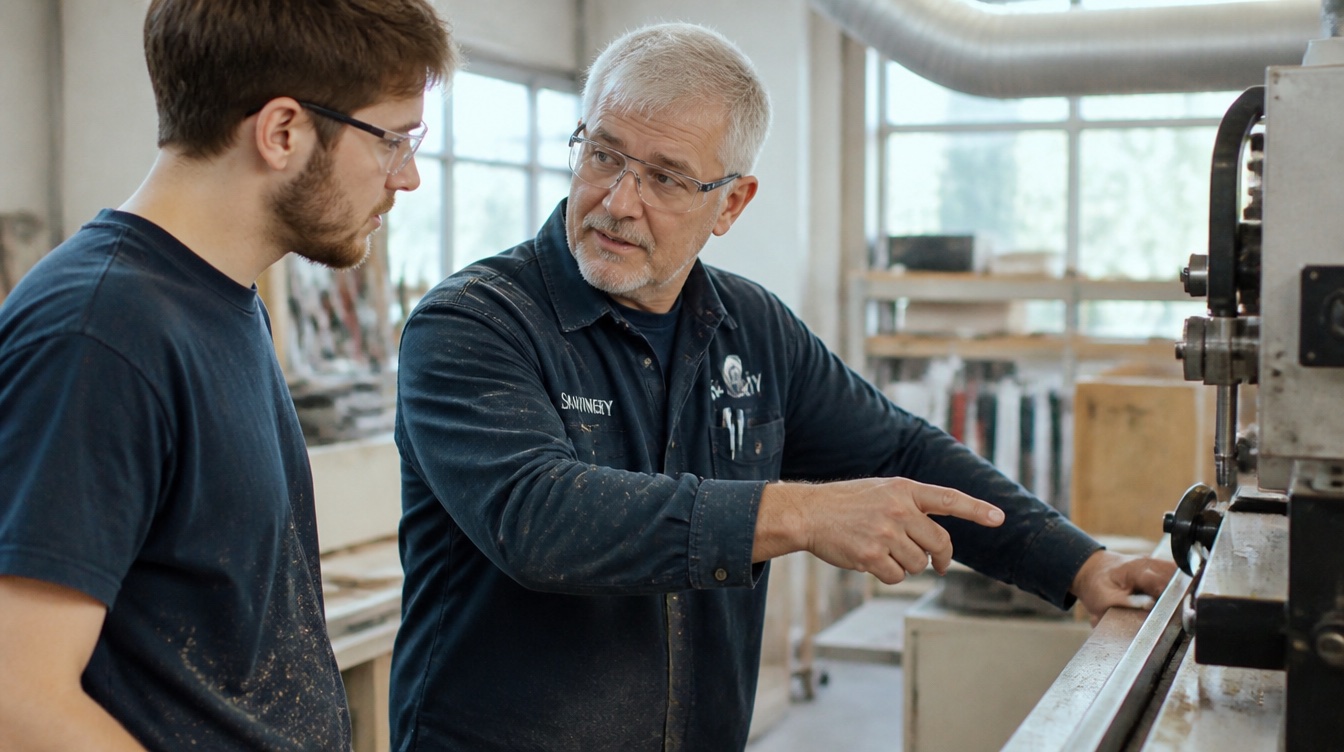
When an experienced foreman retires after 35 years, so too disappears the knowledge of which machine makes which noise, which supplier delivers at short notice, and how a critical handover really works. Such process knowledge isn’t found in any manual. It resides in the minds of long-serving colleagues and is typically passed on verbally. Demographic change turns this into a risk: according to the Federal Statistical Office of Germany (Destatis, 2025 Microcensus), 13.3 million working people in Germany will reach statutory retirement age within the next 15 years — around 30% of all working people. For many companies, this means experience is leaving in large numbers, often faster than successors can build it up. This is exactly where our platform Kibi Connect comes in — with a central wiki and a digital academy that secure operational knowledge and make the transition predictable. GDPR-compliant, with hosting in Germany.
Why does so much operational knowledge disappear with retirement?
Experience-based knowledge is rarely documented — it lives in individuals and is not automatically passed on when they leave.
Without a fixed place for it, it leaves the company with every retirement.
Over the years, shortcuts, workarounds, and quick fixes emerge that have never been written down. Whoever has operated a machine for decades knows its quirks that aren’t in any operating manual. This tacit knowledge is valuable — and fleeting. As long as experienced staff are present, the lack of process documentation goes unnoticed: you just ask. When these individuals leave, operations stall, and successors start from scratch. Labor shortages exacerbate this, as positions are often filled late or not at all, leaving little time for a proper handover. Manufacturing companies and project-based trades are particularly affected, where much knowledge is tied to machinery and construction sites — more on the industry pages Production and Craft & Service.
How does a central wiki secure process knowledge?
A well-maintained wiki permanently captures workflows, checklists, contacts, and special cases — accessible regardless of who is currently working at the company.
This keeps knowledge within the company, not just in individual minds.
The most effective step is to document experience early — not just in the final week before retirement. In a wiki, experienced employees store standard workflows, maintenance instructions, supplier contacts, and typical error patterns. Once documented, this knowledge remains available to successors indefinitely and can be updated as needed. Instead of a folder no one maintains, a searchable knowledge archive is created that is always at hand. It makes sense to treat knowledge transfer as a planned process: clear topics, responsible parties, and a timeframe in which departing employees systematically pass on their knowledge. How knowledge and documents can be centrally consolidated is also shown in the article Providing knowledge and documents centrally.
How does a digital academy make onboarding successors predictable?
A digital academy converts experience-based knowledge into structured learning paths — successors work through them at their own pace instead of receiving everything verbally.
This makes onboarding repeatable and independent of individuals.
Knowledge preservation doesn’t end with documentation — it must also reach successors. In the Academy (LMS), content from the wiki can be bundled into courses: short units on machinery, processes, and safety rules, broken down into digestible steps. New hires complete defined learning paths, repeat content as needed, and build competence step by step. This relieves experienced specialists during the handover phase, as they don’t have to explain every detail personally. It also makes onboarding predictable: you know which topics are covered and where someone stands. How digital onboarding can be achieved in days rather than weeks is described in the article Onboarding employees digitally.
How do you reach non-desk workers in knowledge transfer?
Knowledge must reach where work happens — in the shop floor, workshop, or on-site, not just at a desk.
A web-based platform brings wiki, courses, and documents directly to every shift’s smartphone.
Especially colleagues with the most experience rarely sit at a PC. For these non-desk workers, access must work without a fixed workplace. Through our platform, instructions, plans, and forms are centrally stored in Files and accessible on mobile — instead of scattered network drives only the office knows about. Updates to workflows or new regulations reach everyone reliably via News, directly on every device, rather than a bulletin board only the early shift sees. This ensures secured knowledge is actually used. How to structure the transition for successors is shown on the solution page Onboarding employees.
What measurable benefits does secured operational knowledge bring?
Less dependence on individuals, predictable transitions, and faster onboarding for successors.
Companies that secure knowledge early report concrete improvements:
- Process knowledge remains in the company, even when experienced employees retire or leave
- Less dependence on individuals — workflows are documented rather than only verbally available
- Predictable knowledge transfer instead of last-minute handover in the final working week
- Faster onboarding for successors through structured learning paths and a searchable wiki
- Relief for experienced employees who no longer have to repeatedly explain every detail personally
- Non-desk workers also have mobile access to knowledge, courses, and documents
How does Kibi Connect specifically support knowledge preservation?
Kibi Connect consolidates wiki, academy, files, and news on one platform — designed for operational teams without fixed PC workstations.
Knowledge preservation becomes a continuous process rather than a last-minute effort before retirement.
The components work together: in the wiki, experienced employees document workflows, checklists, and special cases. In the academy, these are turned into learning paths that successors complete at their own pace. In files, plans, instructions, and forms are centrally stored and mobile-accessible. And via news, updates reach all employees reliably — directly on every device. Everything runs web-based on iOS, Android, and in the browser — GDPR-compliant with hosting in Germany (Hetzner), Made in Germany. Learn more on the solution page Centralizing knowledge and documents.
Conclusion: Secure knowledge before experience retires
By documenting operational knowledge early and converting it into learning paths, generational change becomes predictable — instead of losing experience with every retirement.
With around 30% of working people reaching retirement age in the next 15 years and positions hard to fill, verbal handover is no longer sufficient. A central wiki and a digital academy keep process knowledge within the company and make onboarding successors repeatable — for the office just as much as for the many non-desk workers. This way, experience is preserved even when people leave.
Learn more on the solution page Centralizing knowledge and documents and see how the wiki and academy work together.
Next step
Set up internal communication professionally
Want to replace WhatsApp chaos and reliably reach all non-desk workers? We show you in a live demo how Kibi Connect is introduced in production, care and retail operations.
Related articles
06/29/2026
Provide knowledge and documents centrally: Guides, forms, and operational processes on the smartphone
Provide instructions, forms, and operational processes centrally: How an employee platform brings knowledge and documents to the smartphone of every team.
07/22/2026
Document mandatory training with verifiable records: Digital training instead of binders
Mandatory safety training is required and must be verifiably documented. Learn how to digitally deploy required training via an academy and provide seamless proof of completion—even for non-desk workers without PCs.
07/17/2026
Strengthen employee retention in industrial sectors: Reduce turnover among non-desk workers
Strengthen employee retention in industrial settings: How accessibility, belonging, recognition, and fast onboarding reduce turnover among non-desk workers.