Secure and mobile time tracking: What the Federal Labour Court ruling means for businesses
Since the Federal Labour Court ruling of 13 September 2022, employers are required to record working hours. Discover how mobile time tracking at the actual workplace makes this feasible for companies with large numbers of non-desk workers.

Contents
Recording working hours legally and mobile: What the BAG ruling means for companies
Paper notes at the end of a shift, an Excel list in the office, or verbal communication between the shop floor and administration: In many operational companies, working hours are still recorded orally, on paper, or not systematically at all. Since the Federal Labour Court (Bundesarbeitsgericht, BAG) ruling of 13 September 2022 (Ref. 1 ABR 22/21), it has been clear that employers are obliged to introduce a system for recording working hours. For companies with many non-desk workers in production, skilled trades, and catering, this raises a practical question: How can working hours be recorded where no one sits at a desk? This is exactly where our Kibi Connect platform bundles time recording directly at the workplace — mobile on a smartphone, without a time clock, without paper notes, and documented in a traceable manner. GDPR-compliant with hosting in Germany.
What has the BAG ruling of 13 September 2022 changed for companies?
The Federal Labour Court has ruled that employers are obliged under § 3(2) No. 1 of the German Occupational Health and Safety Act (ArbSchG) to introduce a system for recording working hours.
The obligation applies regardless of sector or company size.
With its ruling of 13 September 2022 (Ref. 1 ABR 22/21), the BAG established that this obligation already arises from the Occupational Health and Safety Act. It must be recorded when employees start and finish work and how long they work. The ruling does not specify how the system should be designed in detail — the key point is that working hours are recorded accurately and reliably. At the same time, the Working Time Act (ArbZG) regulates maximum working hours and mandatory rest periods. Reliable recording is the basis for verifying compliance with these requirements in everyday operations. For HR departments and management, this means finding a solution that reaches all employees — not just office staff — including those without a fixed PC workstation. This article does not constitute legal advice; please coordinate the specific design with your legal advisor.
Why is mobile time recording the practical solution for non-desk workers?
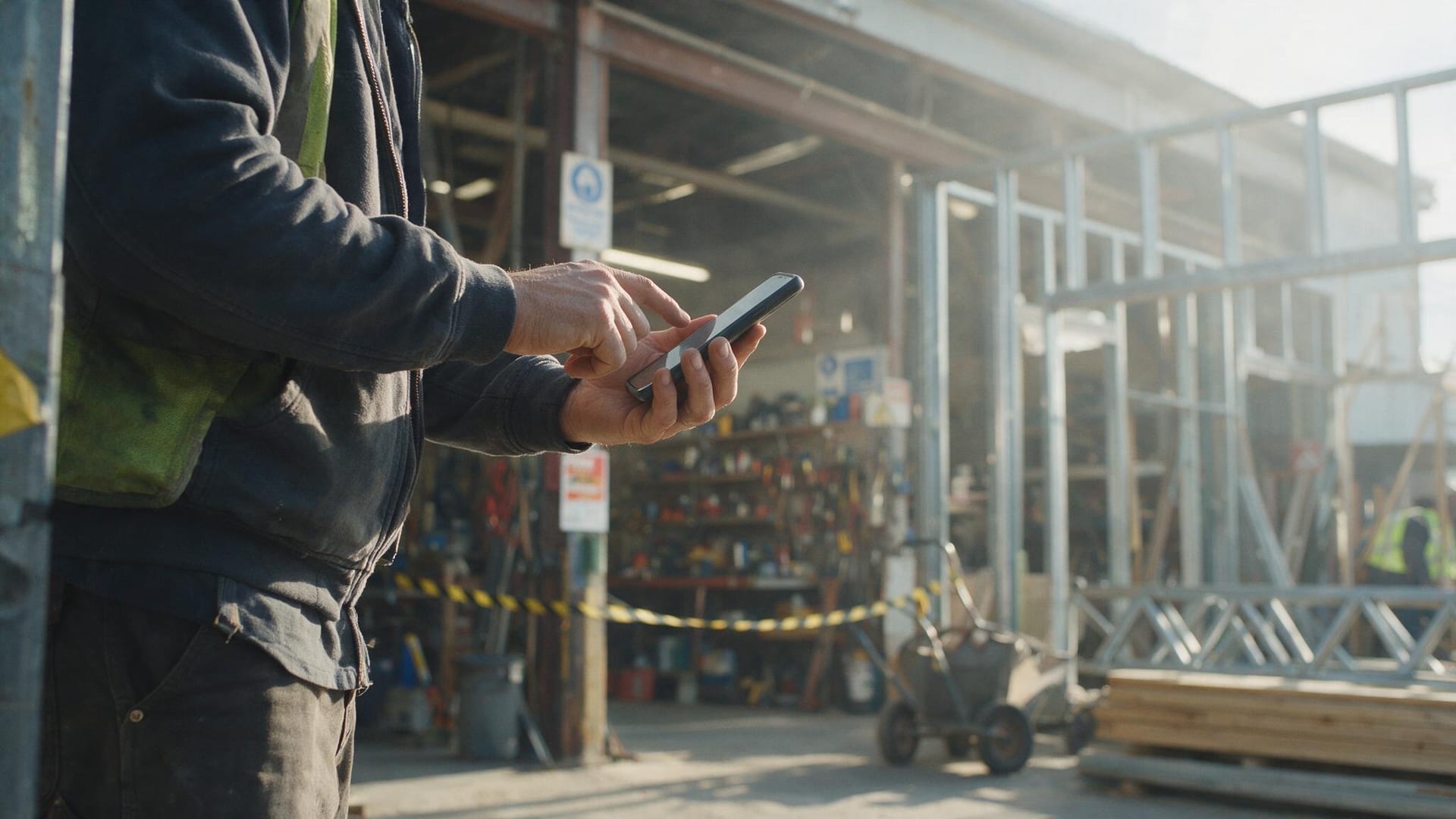
Employees who do not work at a desk need to record their time where the work happens — on their smartphone, in the workshop, garage, or kitchen.
A central time clock at the entrance does not reflect distributed workplaces.
In production, skilled trades, and collective catering, work is spread across workshops, construction sites, vehicles, and kitchens. A fixed time clock at the factory gate is not suitable for this: employees on site visits or moving between stations would have to travel just to record their hours. Paper notes, in turn, arrive late or not at all in the office, are difficult to read, and must be manually entered. Mobile time recording addresses this precisely: employees record start, end, and breaks directly at the workplace on their own or a shared device. We have designed our solution to be industry-specific — from production to skilled trades and service to collective catering. This ensures that even employees who rarely or never sit at a PC in their daily work are reached.
How do employees record their working hours directly at the workplace?
Employees clock in and out via the platform — start, breaks, and end times are recorded with timestamps.
Recording is done without additional hardware or paper.
Instead of paper notes and time clocks, employees open the platform on their smartphone and record their hours with just a few taps. Start, breaks, and end of work are logged with timestamps, and corrections remain traceable. The recorded times are centrally consolidated, so the office no longer has to manually enter notes or search for lists. Since time recording is part of the same platform as the calendar and tasks, working hours can be linked with shifts and assignments — eliminating the fragmentation of multiple isolated solutions. This is particularly beneficial during shift changes: our article on digital shift handover in production shows how smooth digital transitions work. Scattered individual entries become a coherent, up-to-date overview.
How is the recorded working time documented in a traceable manner?
All times are centrally stored with timestamps and traceable changes — always accessible for HR and management.
This documents who worked when and for how long.
The real value emerges after recording: the times must be analysable and traceable. On our platform, working hours are collected centrally instead of scattered across individual notes, chat messages, and Excel files. HR and management can view the current status per person and period without having to compile data from multiple sources. This simplifies payroll accounting as well as monitoring compliance with maximum working hours and rest periods under the ArbZG. Relevant statuses are visible via the dashboard, and since everything is on one platform, information is reliably shared — from the workplace to administration. Documentation is thus complete and retrievable at any time for queries or audits, rather than scattered across folders and loose notes.
What measurable benefits does mobile time recording offer?
Less manual effort, complete documentation, and a recording method that truly reaches everyone.
Companies using mobile recording report concrete improvements:
- Less manual effort: times are recorded once instead of noted on paper and later entered manually
- Complete documentation: start, breaks, and end times with timestamps centrally available for payroll and queries
- Compliance with recording obligations even for employees without PC workstations
- Fewer transfer errors due to the elimination of double entry
- Faster overview for HR and management of current time statuses
- Reliable basis for verifying compliance with maximum working hours and rest periods under the ArbZG
How does Kibi Connect support legally compliant time recording in practice?
Kibi Connect integrates mobile time recording with communication, organisation, and documentation on a single platform — designed specifically for operational teams without fixed PC workstations.
Recording becomes part of daily work, not an additional step.
On our platform, time recording is not an isolated tool but is integrated with other areas. Employees record their hours where they organise team tasks, view appointments in the calendar, and receive updates. This eliminates the need for another login or yet another isolated solution. Since the platform is designed to connect all employees — including the many without PC workstations — recording truly reaches the entire workforce. Everything runs web-based on iOS, Android, and in the browser, GDPR-compliant with hosting in Germany (Hetzner), Made in Germany. For HR departments, this means a reliable, central overview — for employees, a simple action that fits seamlessly into shift routines.
Conclusion: The recording obligation can be implemented practically with mobile solutions
Since the BAG ruling of 13 September 2022, employers must record working hours — for companies with many non-desk workers, mobile recording directly at the workplace is the practical solution.
Time clocks and paper notes do not reflect distributed workplaces in production, skilled trades, or catering. A platform like Kibi Connect records working hours where the work is done, consolidates them centrally and traceably, and reaches even employees without PC workstations. This turns a legal obligation into a process that relieves rather than burdens daily operations.
See how time recording works in Kibi Connect and compare the prices.
Next step
Set up internal communication professionally
Want to replace WhatsApp chaos and reliably reach all non-desk workers? We show you in a live demo how Kibi Connect is introduced in production, care and retail operations.
Related articles
07/22/2026
Document mandatory training with verifiable records: Digital training instead of binders
Mandatory safety training is required and must be verifiably documented. Learn how to digitally deploy required training via an academy and provide seamless proof of completion—even for non-desk workers without PCs.
07/17/2026
Strengthen employee retention in industrial sectors: Reduce turnover among non-desk workers
Strengthen employee retention in industrial settings: How accessibility, belonging, recognition, and fast onboarding reduce turnover among non-desk workers.
07/12/2026
Connect multilingual teams: Enable everyone to work in their preferred language
A multilingual employee platform breaking down language barriers in production, commercial kitchens, and on construction sites — everyone in their own language.